
Thermobonding, Hotmelt, Coating
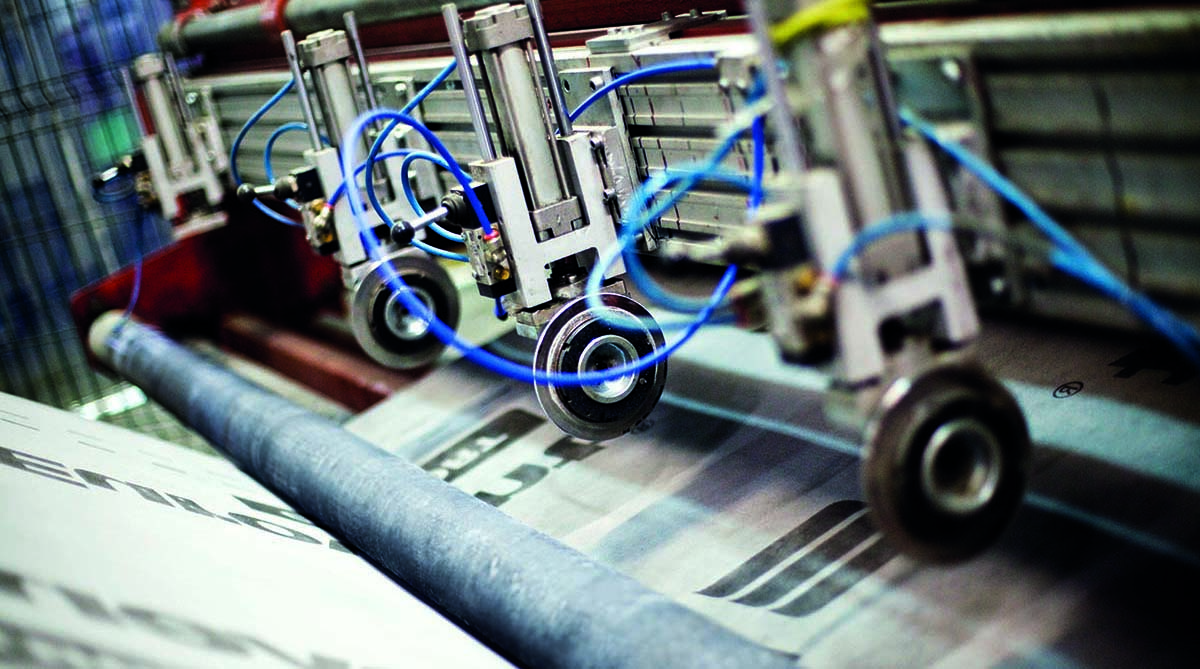
The continuous development of construction technologies and the increasingly diverse applications of breathable membranes create a need for the use of advanced manufacturing technologies, which we would like to introduce to you.
Eurovent® roof membranes are characterized by high durability and resistance to weather conditions. The high-quality polypropylene nonwoven fabrics used in our products feature a dense and uniform distribution of very fine fibres, which ensures excellent mechanical performance – a key factor for roofing products.
Thermobonding
A hot lamination technology – one of the oldest but also one of the most reliable methods used in the production of three-layer roofing membranes with a uniform raw material composition.
Thermobonding involves the thermal bonding of multiple plastic layers forming the laminate using high temperature and pressure applied by laminating rollers. This process does not use any additional substances apart from heat, which results in laminates that are extremely strong and durable. Most importantly, the high temperatures used during production effectively temper the material, increasing its resistance to the extreme temperatures that occur in roof and attic environments.
Structure of membranes produced with Thermobonding technology (from top layer):
- Polypropylene nonwoven fabric [PP]
- Microporous functional film
- Polypropylene nonwoven fabric [PP]
Membranes manufactured using Thermobonding technology:
- Eurovent® BASIC
- Eurovent® CLASSIC
- Eurovent® HOME PRO
- Eurovent® MAXI
- Eurovent® MAXI PLUS
- Eurovent® SUPER
- Eurovent® FORTIS
- Eurovent® COMFORT
- Eurovent® WALL PROTECT 3
- Eurovent® AKTIV ALU
- Eurovent® AKTIV 3
COATING
Coating technology has been widely used in construction for many years and continues to evolve. Within this technology, several variants can be distinguished.
The first is FOAM COATING – a technology based on applying foamed polyacrylic or polyurethane onto a nonwoven fabric. The material is then subjected to a specialized thermal treatment that creates a porous structure. This allows the product to achieve vapour permeability while maintaining watertightness. Products manufactured using this technology are typically designed for pitched roofs.
The second variant is EXTRUSION COATING – a process in which a polymer is extruded onto a nonwoven fabric or another polymer layer and bonded together. This enables the production of multi-layer and reinforced materials.
Coating technology allows the manufacturing of a wide range of products such as reinforced films, breathable membranes, vapour control membranes, metallized films, and façade membranes, which are required to meet high standards of UV resistance.
Structure of membranes produced with Foam Coating technology / three-layer products (from top layer):
- Polyurethane [PU]
- Polyester nonwoven fabric [PES]
Membranes manufactured using Foam Coating technology:
- Eurovent® MAGNUM
- Eurovent® FASSADE X
Structure of membranes produced with Extrusion Coating technology / two-layer products (from top layer):
- Polyacrylic
- Polypropylene nonwoven fabric [PP]
Membranes manufactured using Extrusion Coating technology:
- Eurovent® FASSADE
- Eurovent® STRATOS
- Eurovent® CLIMA
- Eurovent® CLIMA 18
- Eurovent® CLIMA 100
Structure of membranes produced with Extrusion Coating technology / three-layer products (from top layer):
- Polypropylene nonwoven fabric [PP]
- Monolithic functional film
- Polypropylene nonwoven fabric [PP]
Membranes manufactured using Extrusion Coating technology:
- Eurovent® MONO
Structure of films produced with Extrusion Coating technology / three-layer products (from top layer):
- Metallized film [PE]
- Reinforcing mesh [PP]
- Polyethylene film [PE]
Products manufactured using Extrusion Coating technology:
- Eurovent® STANDARD ALU
- Eurovent® STANDARD
- Eurovent® SPECIAL
- Eurovent® STANDARD N
- Eurovent® SPECIAL N
HOTMELT
A bonding technology that is less common in construction but indispensable for the production of products with different chemical compositions and varying properties.
The process involves bonding laminate layers using molten hot adhesive, which is evenly applied to individual layers and then pressed together by laminating rollers. This technology is most commonly used in the production of four-layer roofing membranes, where polypropylene nonwoven fabrics, a functional film, and a polyethylene reinforcing mesh are combined to provide high mechanical strength.
Structure of membranes produced with HOTMELT technology (from top layer):
- Polypropylene nonwoven fabric [PP]
- Microporous functional film
- Reinforcing mesh [PE]
- Polypropylene nonwoven fabric [PP]
Membranes manufactured using Hotmelt technology:
- Eurovent® STRONG
- Eurovent® VSTRONG
- Eurovent® XSTRONG
- Eurovent® CLIMA X
- Eurovent® CLIMA X20


